

After someone dies, you may still want to tell them about your day, hear a familiar song or sit with an object they loved. If spiritual connection is part of your life, those moments may feel like a continuing conversation.
You do not have to choose between cherishing that meaning and being honest about what you know. A dream, impression or reading does not establish that contact occurred. The memory, affection and feeling it brings forward can still deserve care.
Ten gentle starting points
1. Say what is on your mind
Speak privately as you might have spoken to the person, or use a prayer that fits your beliefs. There is no required wording and no need to hear a reply. You can stop after one sentence.
2. Spend time with a familiar object
A piece of jewelry, a recipe or an everyday possession may bring a memory into focus. Notice the memory without requiring the object to produce a yes-or-no answer. You may also put it away when you need rest.
3. Record a dream
If a dream feels important, note the scene and emotion when you wake. You may understand it spiritually, while leaving its source uncertain. A lack of dreams does not mean that love or connection has disappeared.
4. Consider a mediumship reading, if you want one
A reading is optional. Check the approach, fees and limits before booking, and keep the right to disagree. Our guide to preparing for a reading after a loss helps you decide what to ask.
5. Mark a quiet moment with light
An LED candle or a lamp can mark time for remembrance without an open flame. If you use a real candle, follow ordinary fire precautions. A flicker is not a reliable answer to a question.
6. Create a small memory space
Choose a photo, a meaningful object or a digital album. It can be temporary and simple. You do not need to display everything, and changing the space later does not diminish your care.
7. Listen to familiar music
Play a song the person enjoyed or one linked with a shared time. Notice what it brings up, including mixed feelings. Our article on songs that feel like signs explores that experience in more detail.
8. Spend a little time outdoors
A walk, a garden or sitting near a window may give you room to remember. You may notice a bird, feather or butterfly. You can value an association without collecting evidence or requiring nature to respond.
9. Write a private letter
Use paper, a phone note or a voice memo. Say what you miss, what remains unresolved or what you wish you could share. You do not need to send it anywhere, finish it or make it sound forgiving.
10. Take an optional quiet pause
Sit comfortably, set a simple intention and allow a few moments of reflection. Images and memories may arise, or nothing particular may happen. Close by returning attention to your surroundings and the next ordinary part of your day.
Choose one, rather than making a task list of grief
These are invitations, not stages to complete. You may want connection on one day and distance on another. A song that comforts you today may be too much next week. Adapt the practice to how you feel, and do not measure love by how often you repeat it.
Cruse Bereavement Support offers ways to remember someone, including music, stories and letters. You can use those ordinary forms of remembrance with or without a spiritual interpretation.
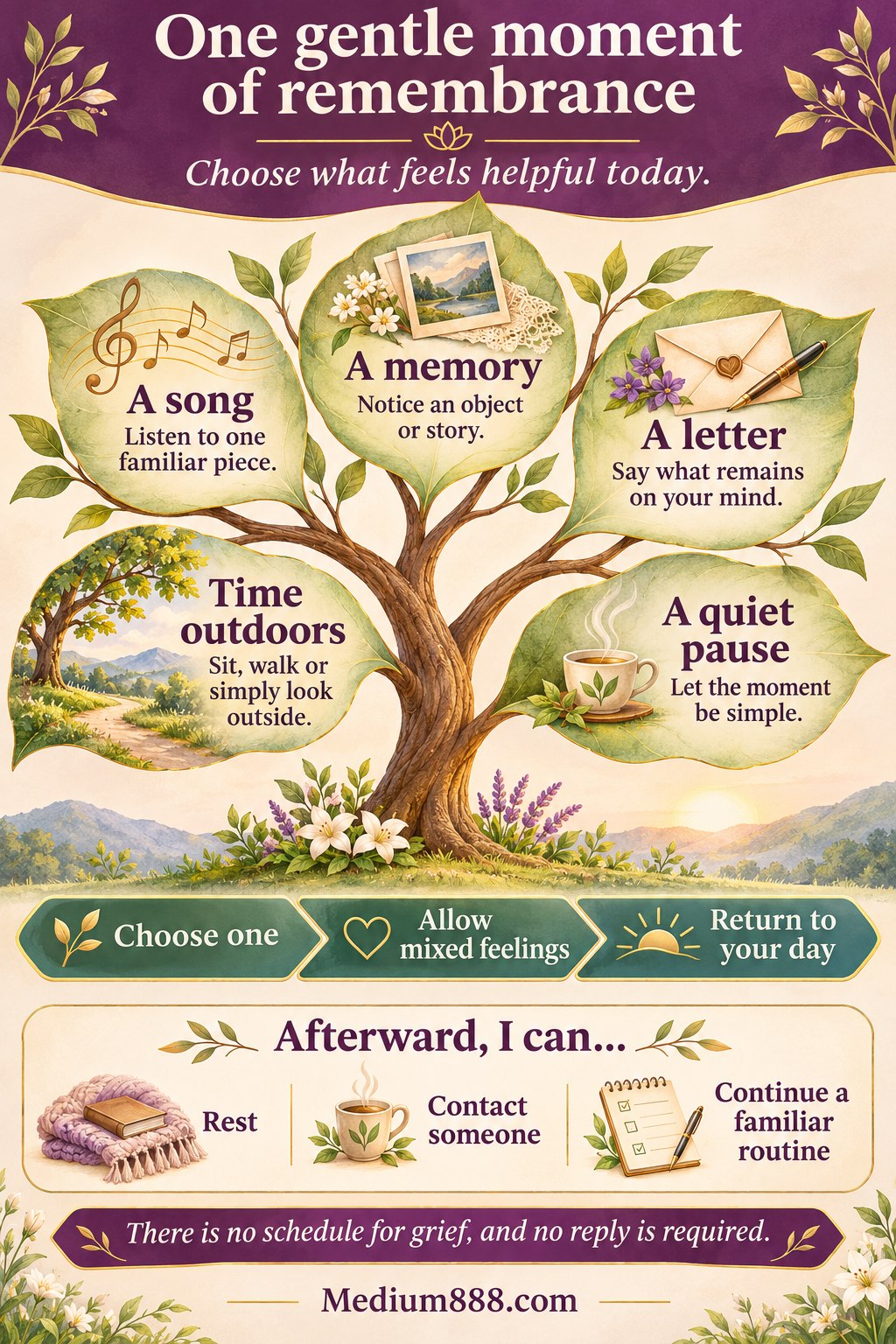
Free remembrance-moment planner
Copy this short plan into a private note. Leave any line blank if it does not help.
- Today I would like: company, quiet, a memory, a practical task or a break.
- One thing I will try: a song, photo, letter, walk or another familiar activity.
- My comfortable limit: a few minutes, one song or another clear stopping point.
- What I noticed: a feeling, thought, memory or no particular response.
- Meaning I am choosing: the association that matters to me, without needing certainty about its cause.
- Afterward I can: contact someone, eat, rest, continue a routine or ask for support.
Example: “I will listen to one song my sister enjoyed. I may feel comforted or sad. Afterward I will text a friend and take a short break.”
If you book a reading, keep your choices intact
Agree on the format, cost and subjects you do not want discussed. Ask whether you may take notes and how your privacy will be handled. You can say “that does not fit,” decline a question or end a session under the agreed terms.
No reader can guarantee that the person you hope for will appear. You are not responsible for making a reading work by accepting every statement. Avoid pressure to buy repeated sessions, remove a curse or act on a claimed message before you have considered the real circumstances.
You do not need to gather another person’s private family details to help a reading along. Share only what you choose. For more support with those decisions, see healthy mediumship boundaries during grief.
When the feelings are complicated
Love can coexist with anger, relief, regret or unfinished questions. A remembrance practice does not require you to rewrite a difficult relationship or reach forgiveness on a schedule. Nor does an absence of signs mean the person is angry, trapped or withholding love.
If a practice leaves you frightened or unable to manage daily needs, step back and seek support from someone you trust or a qualified professional. Cruse discusses experiences of sensing someone who has died and the feelings around them. You can talk about your experience without having to settle its spiritual explanation first.
Frequently asked questions
1. How can I feel connected with a loved one who died?
You might choose a photo, song, letter, familiar object or quiet moment. The practice can have personal or spiritual meaning without requiring a reply.
2. Do these activities guarantee spirit contact?
No. They offer ways to remember and reflect. An impression, dream or reading does not establish that contact occurred.
3. Is it okay to speak to someone who died?
You may find private conversation or prayer meaningful. There is no required wording, and you do not need to hear a response.
4. Must I keep all of their belongings?
No. You can choose what to keep, share or put away at your own pace. Possessions do not measure the value of your relationship.
5. Does a comforting dream mean a visitation happened?
You may understand it spiritually, but the dream does not establish its source. Its feeling and memory can still matter to you.
6. What if I do not dream about them?
A lack of dreams does not mean love, support or connection has been withdrawn. You do not need to produce a particular experience.
7. Do I need a candle for remembrance?
No. An LED candle, lamp, photo or no object at all can be enough. A flame’s movement is not a dependable answer to a question.
8. Can I make a digital memory space?
Yes. A private album, playlist or voice memo may suit you better than a physical display. Choose what feels manageable.
9. What if a favorite song makes me sad?
You can stop, choose another activity or ask someone to sit with you. A meaningful practice does not have to feel comforting every time.
10. Should I send the letter I write?
You do not need to send it. A private letter, phone note or voice memo can hold what you want to say.
11. Is a mediumship reading necessary?
No. It is an optional choice, not a requirement for grieving, remembering or maintaining a sense of connection.
12. Can I disagree during a reading?
Yes. You may say a statement does not fit, decline a question and keep the limits you agreed before the session.
13. Does a lack of signs mean the person is upset with me?
No. The absence of signs does not establish anger, rejection or a problem you must pay someone to resolve.
14. What does the free planner include?
It helps you choose one activity, set a comfortable limit, notice your response, name a personal meaning and plan ordinary support afterward.
15. What if I need a break from remembrance?
You can take one. Resting, enjoying daily life or concentrating on practical tasks does not diminish your love.
The article presents an interesting perspective on spirits and their communication. It’s quite enlightening to understand the different methods and the importance of approaching this with caution and respect.
The author does a commendable job explaining the basics of spirit communication. However, I would have appreciated more scientific references or studies to understand the phenomenon better.
It’s fascinating how the article demystifies the concept of spirits and outlines practical steps for communication. My question would be whether different cultures have unique methods for such practices.
Absolutely. For example, in some indigenous cultures, shamans play a crucial role in spirit communication using rituals and ceremonies.
Indeed, many cultures have their distinct ways of communicating with spirits, often rooted deeply in their traditions and beliefs. It would be interesting to explore those variations.
Encouraging practices like meditation and writing to connect with spirits can be beneficial for individuals seeking solace or guidance. It’s important for people to approach this gently and with an open mind.
The advice to avoid tools like Ouija boards for beginners is quite sound. Opening oneself up to any spirit without proper understanding and preparation can indeed be overwhelming.