


If you do not want to fall in love again right now, you can choose not to pursue a relationship. You do not have to date to prove that you have moved on, and you do not have to make a permanent decision about love while a breakup still feels fresh.
What you can choose is your behavior: whether to accept dates, how much contact to have and what you tell someone who is interested. You cannot guarantee that attraction or affection will never arise. A useful aim is to protect your time and make clear choices while treating yourself and other people with respect.
Decide what “not falling in love” means for you
The phrase can describe several different wishes. Choose the one that fits today:
- “I want a complete dating break.” You are not seeking dates, romantic conversations or a new sexual connection. You can pause dating apps and decline invitations.
- “I want to meet people slowly.” You are open to a date, but not rapid commitment or constant contact. Explain your pace rather than assuming the other person understands it.
- “I want a casual connection.” Say so plainly and check whether the other person wants the same. Casual does not mean careless, and it cannot guarantee that neither person will develop feelings.
You may discover that none of these options feels appealing. Staying single without a timetable is a valid choice too.
Make a dating pause concrete
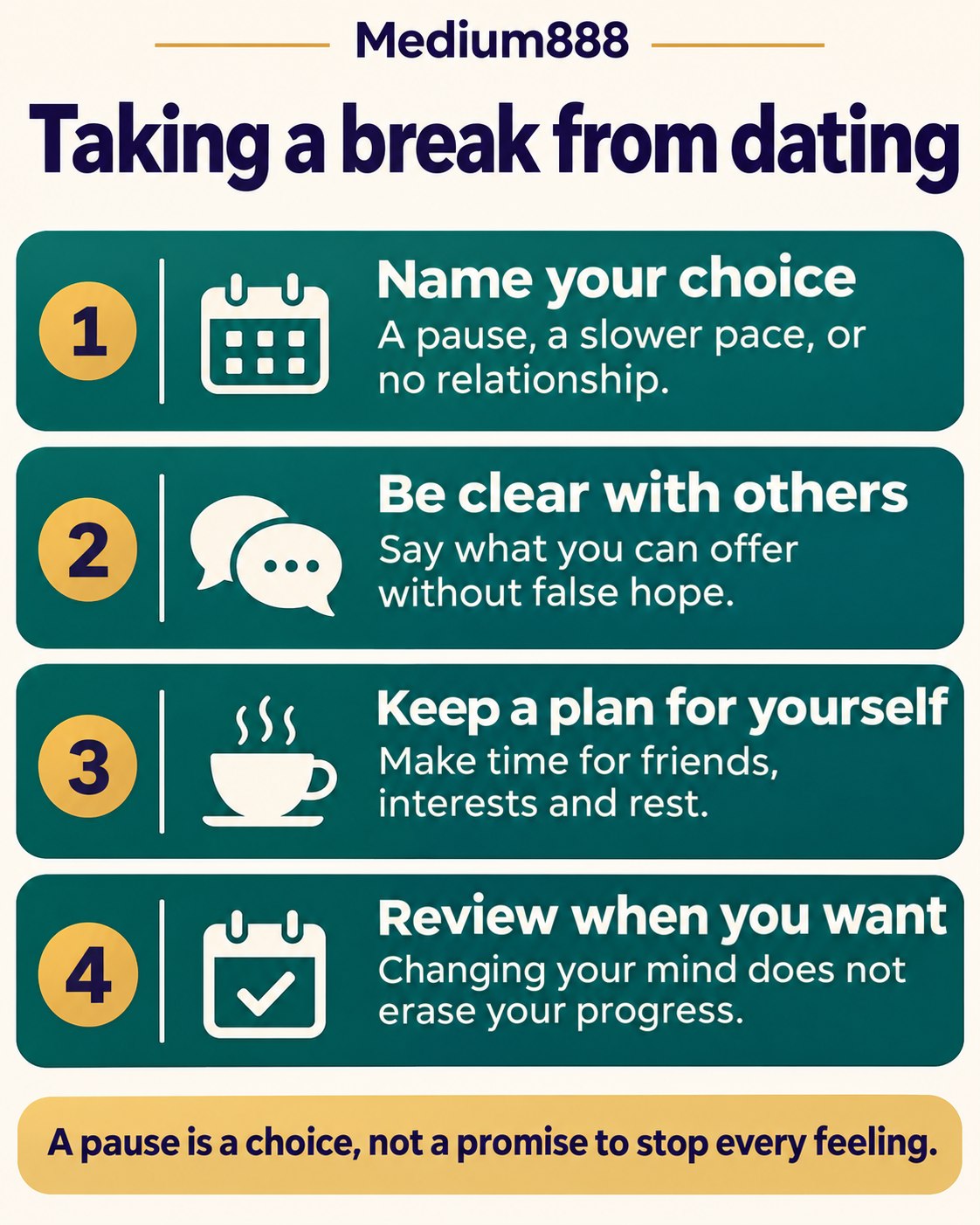
- Name your reason in your own words. “I want time to settle after my breakup” or “I want my evenings back” gives you a clearer direction than “I must never care again.” You do not owe everyone the private details.
- Choose the contact you want to pause. That could mean pausing an app, declining dates or ending a flirtation that keeps becoming more intense. Be specific about what you will do.
- Keep a plan that belongs to you. Arrange time with a friend, return to an interest or leave an evening unbooked. The point is to make room for your life, not to stay so busy that you are never allowed to feel anything.
- Set a check-in if it helps. Choose a day to ask whether the pause still fits. It is a reminder to listen to yourself, not a deadline to be ready for romance.
Tell an interested person what you can offer
You do not need to invent flaws, create an argument or pretend to be busy. A short honest message lets the other person make their own choice.
- To decline a date: “Thank you for asking. I’m taking a break from dating, so I’m going to say no.”
- To end an early flirtation: “I’ve enjoyed talking, but I’ve realized I don’t want to start a romantic connection. I don’t want to keep giving a different impression.”
- To explain a slower pace: “I’m open to another date, but I don’t want to rush into a relationship. How does that fit with what you want?”
Use only the message that is true for you. “Maybe later” can leave an expectation you did not mean to create. You can be kind without promising future interest.
Love is respect’s guide to boundaries and expectations explains why expectations need a conversation rather than an assumption. The other person may decide that your pace or availability does not work for them. Their choice deserves room alongside yours.
If you are considering casual intimacy
Ask whether you actually want it, rather than using it as a test of whether you are over your ex or able to stay detached. You can decide not to have sex, and you can change your mind about an arrangement that no longer feels right.
Discuss what “casual” means to both of you. Do not assume that it means exclusivity, friendship, no sleepovers or no feelings. RAINN’s guidance on consent emphasizes clear, voluntary and ongoing agreement. Previous flirting or intimacy is not automatic permission for the next occasion.
If you want different things, a respectful end to the connection may be clearer than continuing while hoping the other person will stop caring. Someone else is not a tool for keeping your own feelings at a distance.
A fictional example: a pause that leaves room for life
Casey, 48, has been checking dating apps whenever an evening feels lonely after a breakup. Casey does not really want to meet anyone and keeps canceling plans. A month-long pause feels more honest than accepting another date out of obligation.
Casey sends one person the early-flirtation message above, pauses the app and books a watercolor class that had been put off for months. On the first quiet Saturday, Casey still misses the former partner. That feeling does not mean the pause has failed; Casey can miss someone and still choose not to start a new relationship.
At the end of the month, Casey can extend the pause, try one date or keep focusing on other parts of life. The review is a choice, not a score.

When feelings appear anyway
Try naming the experience without immediately turning it into an instruction: “I am attracted to them,” “I miss the attention,” or “I want to know them better.” You can notice the feeling and still decline a date.
Then look at the choice in front of you. Would more private time fit the pause you wanted? Would you prefer to keep a friendship in a group setting? Is the other person comfortable with that? If your wishes have changed, tell them before behaving as though a new agreement already exists.
You do not need to punish yourself by listing everything you dislike about someone, comparing them with an idealized ex or trying to become less caring. Attraction does not remove your ability to make a deliberate choice.
Keep necessary contact with an ex clear
If you share work, parenting, housing or belongings, complete silence may not be practical. Decide which matters need a response and, where possible, use a clear channel for those arrangements. A conversation about collecting keys does not have to become a conversation about getting back together.
If contact involves threats, control or fear, get support tailored to your circumstances before relying on a generic breakup script. You can ask a trusted person or specialist service to help you consider safer options.
You can choose differently later
Wanting a relationship again does not make an earlier pause dishonest. Continuing to prefer single life does not mean you have failed to heal. A useful question is “What do I want and have room for now?” rather than “Have I made myself impossible to hurt?”
When you do want to explore a connection, keep the same habits: honest intentions, a pace you can sustain and room for both people to say yes or no.
Questions about taking a break from love
1. Can I stop myself from having romantic feelings?
You can choose whether to pursue a connection, but you cannot guarantee that feelings will never appear. Notice what you feel, then decide what contact and commitments fit your wishes.
2. How long should I take a break from dating?
There is no required timetable in this plan. You can set a personal check-in date, extend the pause or leave it open-ended. A check-in does not obligate you to start dating.
3. Do I have to try casual dating instead?
No. Casual dating or intimacy is optional, and it does not guarantee emotional detachment. Choose it only if you want it and everyone involved understands the arrangement.
4. Should I disappear to avoid giving someone hope?
When it feels safe, a clear brief message is usually easier to understand than continuing to flirt while avoiding plans. If there are threats or fear, seek individualized support instead of relying on a standard message.
5. What if the other person wants a relationship and I do not?
Explain what you can offer and accept that they may not want the same arrangement. Do not ask them to wait or continue a casual connection if that does not suit them.
6. Does wanting love again mean my break failed?
No. A pause can help you make space for your own priorities without requiring a permanent decision. You are allowed to review your wishes and communicate a change honestly.
Though the article provides practical steps to avoid heartbreak, it does so at the cost of authentic human experiences. Vulnerability and emotional connections are integral to personal development and finding true companionship.
The advice here is interesting but seems to be rooted in a fear of emotional pain rather than promoting a balanced approach to relationships. Learning to manage one’s emotions and selecting partners wisely might be more effective in the long run.
This article suggests a rather cynical approach to relationships. It might serve as a temporary solution for avoiding heartache, but it doesn’t seem like a sustainable way to build meaningful connections.
While some of the methods mentioned here could help someone avoid heartbreak, they seem to be encouraging a rather superficial and emotionally detached way of living. Everyone’s journey to healing is different, but genuine connections might be more rewarding.
The strategies outlined here seem to prioritize avoidance over genuine emotional growth. It’s important to develop healthy coping mechanisms rather than simply shutting oneself off from potential relationships.