


If you feel drawn to mediumship, you may be wondering how to begin without copying the drama of a television reading. Start with a modest aim: learn the language, notice your own impressions and develop a practice that leaves room for uncertainty and honest feedback.
Within mediumship traditions, a medium is understood as someone who seeks communication with people who have died. People describe those experiences in different ways. Interest, empathy or a vivid dream can be a reason to explore the subject; none, by itself, certifies an ability to contact spirits.
Understand the terms before choosing a method
A psychic reading may focus on personal questions and intuitive impressions. A mediumship reading specifically concerns claimed communication with the deceased. Some practitioners use both descriptions, but there is no universal rule that every medium works the same way. Our guide to mediums and channelers explains another distinction you may encounter.
Clairvoyance: images
A practitioner may describe an inner picture, scene or symbol. Record the image before deciding what it means. A mental image is different from an externally verified event.
Clairaudience: words or sounds
Some describe a phrase or sound within an impression. Keep the experience separate from certainty about who produced it. Hearing an unexplained voice is not a test of mediumship.
Clairsentience: feelings
People may describe an emotion or bodily association. Note what was already happening in your body and surroundings; discomfort does not establish someone else’s illness or a spirit’s presence.
Claircognizance: a sense of knowing
A conclusion may arrive quickly without a clear chain of thought. Record it as an impression and consider what information or expectations may have contributed.
You may also hear terms for scent, taste, channeling or energy reading. These describe how practitioners interpret experiences; they do not make an unexplained sensation proof of a gift. Likewise, empathy is valuable without requiring a supernatural explanation.

A short beginner practice
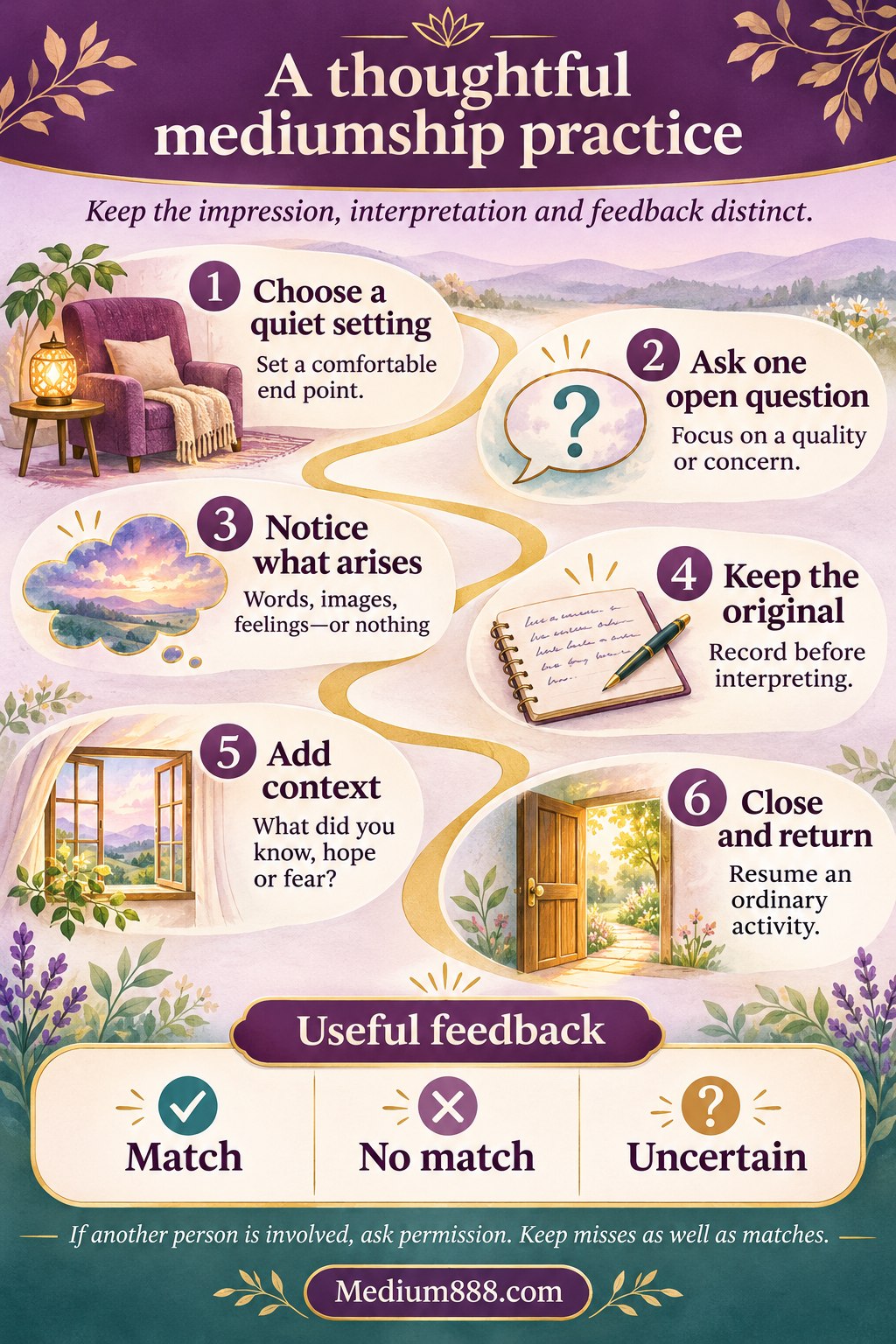
- Choose a comfortable setting. Sit somewhere familiar, with an ordinary end time. You can keep your eyes open.
- Set one intention. For example, “I want to notice what comes to mind and describe it honestly.” Use a prayer if that fits your beliefs.
- Take a quiet pause. Notice images, memories, words or feelings without forcing an experience. A few minutes is enough to begin.
- Record the first description. “A blue doorway came to mind” is clearer than immediately expanding it into a detailed life story.
- Consider context. What had you recently seen, discussed or hoped for? What other explanation could fit?
- Close the exercise. Return attention to the room and continue your day. No particular impression is required.
Regularity can help you become more familiar with your own attention and associations. It does not guarantee spirit contact. Avoid treating tiredness, fear, sleeplessness or headaches as milestones you need to endure to improve.
Practice with another person only by agreement
Ask first, explain that you are practicing and allow the other person to decline or stop. Do not approach a grieving stranger with an unsolicited message. Agree on subjects that are off limits and whether either of you wants notes kept.
Describe an impression without leading the person toward a match. “I pictured a garden; does that mean anything to you?” is more honest than trying successive relatives and details until someone agrees. Record misses, vague matches and corrections alongside apparent matches. Do not turn “that does not fit” into a claim that the person is closed off.
Free mediumship-practice log
Copy these headings into a private note. Keep your first description unchanged and add later comments separately.
- Date, duration and context: where was I, and what was already on my mind?
- Intention: what did I agree to practice?
- Original impression: the image, phrase or feeling as it first appeared.
- Interpretation: what did I think it might mean?
- Feedback: the other person’s actual response, including no match.
- Other explanations: prior information, broad wording, memory, expectation or coincidence.
- Next step: a skill to practice, a question to ask or a reason to rest.
Review fairly: a run of apparent matches does not make every later impression reliable. Keep a full record rather than saving only the moments that felt striking.
Tools are optional
Tarot or oracle cards may give you a symbolic starting point. A crystal, bell or familiar object may mark a quiet moment. None is required, and buying more equipment does not certify contact or make an impression accurate.
If you use cards, distinguish what is visible in the artwork from what you added intuitively. If you use a pendulum, do not treat a movement as independent confirmation of your interpretation. You can practice without smoke, oils, candles or elaborate rituals.
What to ask a teacher or development group
- What will the sessions actually involve, and what are the total fees?
- How are consent, confidentiality and feedback handled?
- Can participants question a claim or report that nothing matched?
- What subjects are outside the group’s scope?
- Can I leave or take a break without pressure to buy another course?
A certificate can show that someone completed a particular course; it does not establish verified spirit communication. Avoid teachers who promise guaranteed powers, insist that criticism blocks your gifts or demand paid clearing before you can safely stop.
Keep compassion central
If you hope to read for others, the responsibility extends beyond producing an impressive detail. Respect privacy, keep fees clear and never promise a particular deceased person will appear. Do not diagnose, predict a death or tell someone they must forgive, spend money or remain in a relationship.
Our guide to healthy boundaries during grief is useful whether you are practicing or booking a reading. A careful practice makes room for questions, ordinary support and the freedom to stop.
Frequently asked questions
1. How can I begin exploring mediumship?
Learn the terms, choose a short quiet exercise and record impressions before interpreting them. Keep the aim modest and leave room for uncertainty.
2. Does strong empathy mean I am a medium?
Empathy can matter to you without certifying communication with spirits. It is not, by itself, proof of mediumship.
3. Are psychics and mediums the same?
A psychic reading may concern intuitive impressions about personal questions; mediumship specifically concerns claimed communication with the deceased. Practices and labels vary.
4. What does clairvoyance mean in this context?
Practitioners use it to describe an inner image or symbolic scene. The image should be distinguished from a verified external event.
5. Are unexplained voices proof of a gift?
No. Unexplained voices and other sensory experiences deserve appropriate medical attention rather than being used as a test of mediumship.
6. How long should a beginner practice?
Begin with a few comfortable minutes and an ordinary end time. Stop if the practice becomes distressing or interferes with rest and daily life.
7. What if nothing comes to mind?
That is a valid result. You do not need to force an image or interpret the absence of an impression as failure.
8. Do I need tarot cards or crystals?
No. Tools may provide a symbolic or personal focus, but they are optional and do not certify accuracy or contact.
9. Can I practice on someone without asking?
Ask for clear agreement first. The other person should be free to decline, set limits and stop. Avoid unsolicited messages to grieving people.
10. How should I respond when an impression does not fit?
Accept the feedback and record it honestly. Do not pressure the person to find a match or blame their attitude.
11. What belongs in the free practice log?
Record context, intention, the original impression, your interpretation, actual feedback, other explanations and a sensible next step.
12. Does a course certificate prove mediumship?
It may document completion of that course. It does not establish verified spirit communication.
13. What should I ask a teacher?
Ask about session content, fees, consent, confidentiality, honest feedback, limits of practice and your freedom to leave.
14. Should I push through headaches or lost sleep?
No. Symptoms are not required milestones. Rest and seek appropriate care rather than interpreting discomfort as proof of progress.
15. Can a beginner guarantee contact for a grieving person?
No. Do not promise a specific person will appear or that a session will provide closure. Keep expectations, consent and boundaries clear.
The distinction between a medium and a psychic is quite enlightening. The article provides a clear explanation of their unique abilities and roles, which helps demystify common misconceptions.
The practical advice on how to prepare for a reading is pragmatic. Having an open mind and setting the right expectations seems crucial for a meaningful experience.
The methods for developing mediumship skills are well-outlined. Continuous practice and meditation seem to be key elements in honing these abilities.
I agree. The emphasis on belief and peacefulness suggests that mental state plays a significant role in mediumship.
Indeed, finding a trusted medium for guidance can make a substantial difference in one’s journey to develop these gifts.
The historical context regarding mediumship is informative. It’s intriguing to see that communication with spirits has deep roots in various cultures.
The list of signs that one might be a medium is particularly interesting. It’s a good starting point for anyone who believes they might have these gifts to explore further.