

Updated
After someone dies by suicide, questions about their spirit, their feelings or the reason for their death may have no answer you can verify. You can make room for spiritual beliefs while protecting yourself from claims presented as certainty. A mediumship reading is not required to remember someone, grieve or receive support.
What can be said honestly about spiritual questions?
Families and faith communities hold different beliefs about death and an afterlife. This article cannot verify what happens to a spirit after suicide, attribute messages to someone who died or tell you what that person now feels. Statements that every spirit regrets the death, remains on earth or sends the same apology should not be presented as established facts.
If a belief brings comfort, you can describe it as your belief. You can also feel uncertain, disagree with an interpretation or prefer to leave spiritual questions alone. No one needs to prove that they received a sign before their love or loss can be taken seriously.
A person’s death should not be used to frighten relatives with claims of punishment, negative energy or an urgent need to pay for spiritual intervention. You can decline those explanations without making a decision about every aspect of your faith.
Give grief room without assigning blame
Grief is not a task with one correct sequence or a deadline. People within the same family can respond differently. You may want conversation on one day and privacy on another. An emotional response is not proof that you failed to think positively or that you are surrounded by harmful energy.
The American Foundation for Suicide Prevention (AFSP) resources for suicide-loss survivors include peer conversations, educational materials, information about support groups and ways to find clinicians familiar with suicide bereavement. AFSP notes that it lists support groups as a public service; a listing is not an endorsement of a particular group.
You can ask a service what it offers, who facilitates it, how confidentiality works and whether it fits your needs. If talking in a group does not feel right, ask about other options. Support should make room for your experience rather than require a particular spiritual explanation.
Three choices you are allowed to make
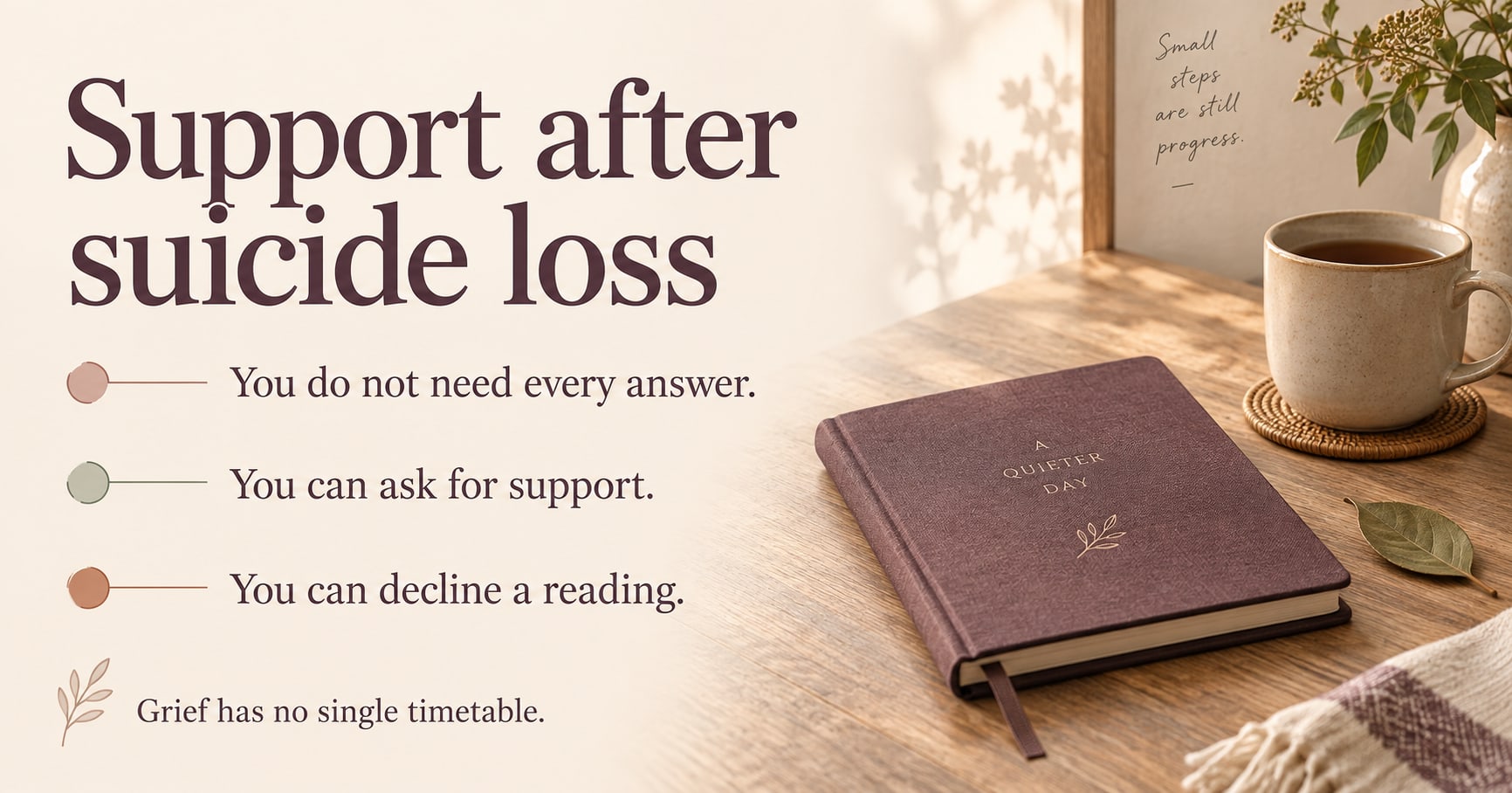
The featured graphic offers these reminders, with their practical meaning explained here:
- You do not need every answer. You can separate facts you know from questions that remain unresolved. When a question feels overwhelming, it is okay to pause the search and ask someone to stay with you or help with an ordinary task.
- You can ask for support. Make a specific request if that is easier: “Could you sit with me for a while?” or “Can you help me contact a bereavement service?” You do not have to explain everything neatly before asking.
- You can decline a reading. You may postpone, stop or decide never to have one. No claimed message creates an obligation to buy another session, change treatment or make a major life decision.
Keep remembrance under your control
You might write down a memory, keep an ordinary object, share a story or observe a familiar tradition. These are options, not instructions for producing contact with the dead. Doing nothing ceremonial is also a choice.
Choose what you want to share and with whom. You can tell a friend, “I want to talk about their life, but I do not want speculation about the death today.” Other relatives may choose differently. A boundary can protect a conversation without requiring everyone to grieve in the same way.
When practical responsibilities or future plans feel too large, our guide to revisiting personal goals after loss offers an optional way to separate immediate tasks from decisions that can wait. It does not set a timetable for grief.
If you are supporting someone who is struggling
Listen without judgment and offer concrete help, such as making a call together or accompanying them to an appointment. Avoid promises that everything will soon become positive, claims that suffering was sent to teach a lesson, or comments intended to make someone feel guilty for being distressed.
If you are concerned about suicide, NIMH recommends asking directly, listening, helping the person stay safe, connecting them with support and following up. Asking about suicide does not increase suicidal thoughts. A spiritual conversation can accompany human support, but it should not replace crisis care.
There is no need to purchase certainty about the spirit world to deserve companionship, remembrance or professional help. Grief has no single timetable, and support can remain available while questions remain unanswered.
The emphasis on finding happiness and dealing with the past is a practical takeaway from the article. Focusing on positive thinking and gratitude can indeed be beneficial for mental health.
Positive thinking and gratitude are powerful tools for mental well-being. It’s nice to see these concepts being reinforced, especially in the context of countering suicidal thoughts.
Indeed, mental health strategies like these should be more widely promoted. They can offer immediate coping mechanisms while waiting for professional help.
While the spiritual insights presented here are intriguing, it’s crucial to emphasize mental health support and encourage people to seek professional help. Beliefs in the spirit world might offer comfort to some, but tangible assistance is necessary for those struggling with suicidal thoughts.
The article’s advice to seek a reading for positive affirmations is unique, though it might not resonate with everyone. It’s important to approach this with an open mind but also to rely on established mental health practices.
Yes, while readings can be comforting for some, they should not replace conventional mental health treatments. It’s all about finding what works best for the individual and ensuring they have access to proper care.
The article raises some thought-provoking points about the aftermath of suicide in the spiritual realm. It’s fascinating to consider the perspective of mediums and how they interpret messages from spirits. However, it would be interesting to see more empirical studies or evidence to substantiate these claims.
The notion that spirits who committed suicide might want to apologize is compelling. It opens a dialogue about unresolved emotions and the impact of suicide on those left behind.
This perspective suggests that there’s continuity in the emotional experiences of the soul, even after death. It points toward a need for greater understanding and compassion for those who feel they have no way out.
I agree. The idea that spirits have regrets aligns with what many grief counselors say about the feelings of survivors. It’s a perspective that might provide solace to grieving families.